


I moved to Washington DC after college and tried joining a few different social groups. Most didn’t work for me, often because they felt too overwhelming or unstructured. But one that stuck was a book club. It was a pain to get to, requiring two train transfers to get from the Maryland side of the DC area to the Virginia side. But once there, the structured conversation generally felt easy and resulted in some lasting friendships.
What made the difference? A new paper out in Social Psychological and Personality Science looked at 1,500 users of the EventBrite platform to ask: What sorts of events leave people feeling most connected, and for who?
The key factors they looked at included:
Did you go alone or with other people?
Was the event indoors or outdoors?
Was the event paid or free?
Was it a recurring event or a one-time thing?
Was the event about watching/observing something, or interacting with other attendees?
The authors looked at a bunch of individual differences, too, like how extroverted people are, how trusting they are, and how happy they are with their lives in general.
Now, let’s take a look at the data:
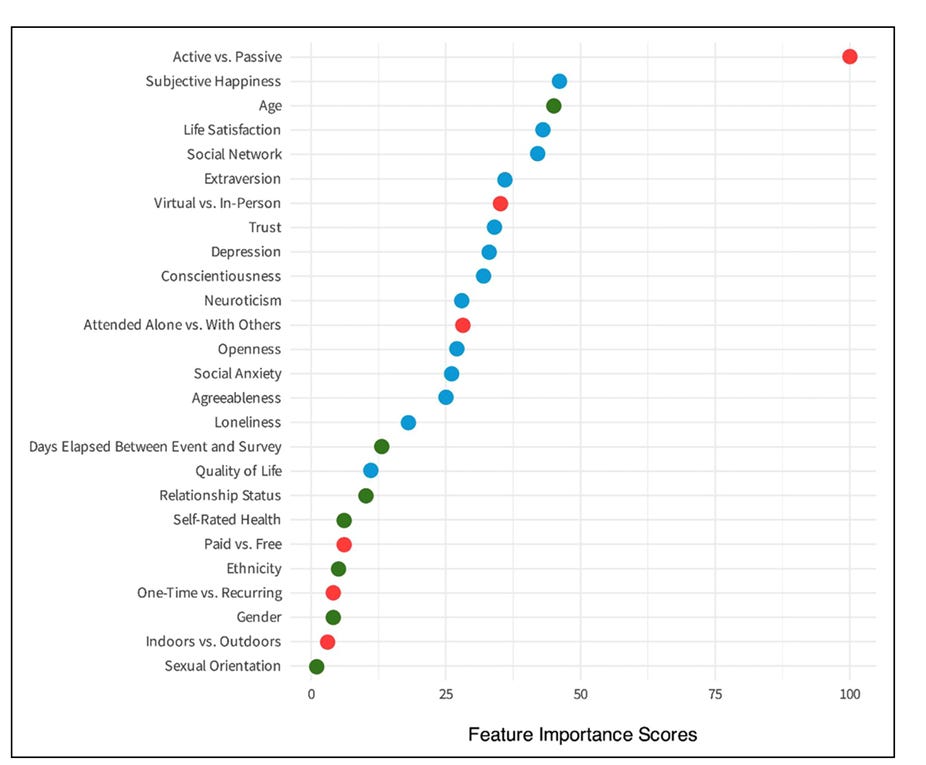
The further a dot is to the right, the stronger its impact on feelings of connectedness. A few interesting findings stand out.
First, people who are already in good spirits tend to feel connected when they go to social events. An interesting implication: you can’t simply go to a social event and expect it to “fix” your unhappiness or cynicism. Our well-being and our reactions to social events feed into each other.
Second, some features of an event don’t matter much. Paid versus free is nearly irrelevant, for instance. And here’s a more surprising one: going alone versus with friends matters far less than we’d intuit. Plenty of people feel connected at events they go to alone, or disconnected at events they go to with other people.
The true standout finding, though, is just how impactful “active” events are over “passive” ones.
So what does that mean? Digging into the paper’s supplementary materials, the question looked like this:
“This event involved…(1 = Active participation (able/encouraged to interact with other attendees of the event), 2 = Passive participation (audience, just listening or observing), 3 = Other (please specify)”
In other words, the most important feature of an event for feeling connected was some sort of opportunity for structured interaction. We tend to over-index on who we’re with, but what we do when we get there is more important.
The tricky part is that “structured interaction” can be painful. Done wrong, I’m reminded of an uncomfortable corporate icebreaker. Particularly for more anxious or introverted people, I suspect the key is low-pressure interaction with clear rules. The book club I attended in Washington DC didn’t just say “talk amongst yourselves.” There was a structure: go around the room and share your favorite part of the book; debate the book’s thesis or the morality of the protagonist.
In past articles I’ve talked about the virtues of social single-tasking, and I think the principles apply well here too. If you want to feel connected, find a path to low-pressure interaction with other attendees. Have one conversation. Have another if you’re up for it. And if you’re in a book club in Virginia, make sure you wrap up in time to catch the last train back to Maryland.